
Just like a blog, but with a whole bunch of friends!
Why I blog?
Every now and again a blogger asks themselves, just why do I do this?
The answer for me has always been clear. I really love nature and I love sharing my passion with people. The other reason is that blogging about what I see and experience gives me just another reason to get out in to nature.
So, for those who do not know me, I’ll try give aquick breakdown of some of the paths that I have taken my life down so far…
South Africa
I grew up just west of Durban, a sub-tropical city on the coast of KwaZulu-Natal, South Africa. Forest, Natal Robins, Crowned Eagles. I started birding as a young kid and spent as much time as possible in the coastal forests, grasslands and savanna of KZN. The bush lives in me.
My university studies took me through a degree in Wildlife Science, with Zoology on the sideline, and I wrote a final thesis on Bird Movement and Migration in Southern Africa, analysing the movement patterns of all of southern Africa’s 900 bird species (interestingly, about 45% of all bird species in southern Africa are nomadic!). I then wrote an MSc thesis on the vertebrate biogeography of southern African forests (what is where and why). I was able to figure out where there were and weren’t forests 18,000 years ago – the key factor in determining forest assemblage composition in the region. All the while at university, I helped and worked on various ornithological studies (including many years on my beloved Cape Parrots), and ringed thousands of birds, including Spotted & Orange Ground Thrushes (my favourite).
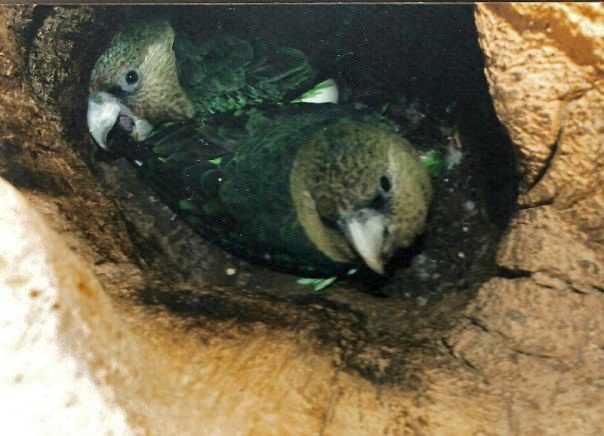
Cape Parrots in nest
Costa Rica
I then ran the conservation and field work for a Costa Rican conservation organisation that focussed on the reintroduction of captive-bred Scarlet Macaws (mainly based south of Corcovado National Park, on the border of Panama). There were so many fascinating things the macaws taught me about the jungle. We put a huge amount of effort in to the theory and practice of reintroduction, resulting in an exceptionally successful project, with a now functional population of breeding macaws. Costa Rica, what can I say, 3 years of parrots (9 spp in one day!), sloths, hummingbirds and King Vultures.
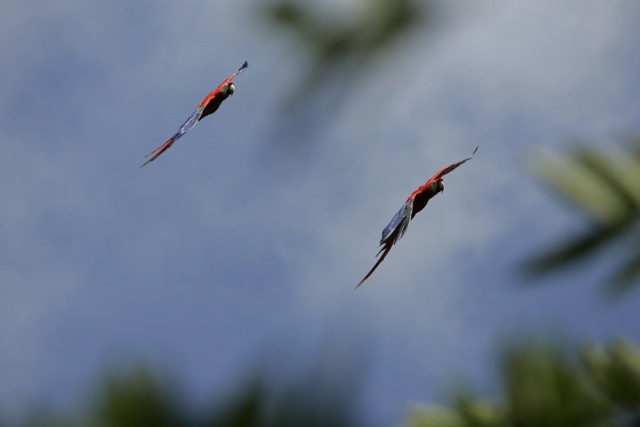
Two young male Scarlet Macaws (a pair) coming in to land. Image (c) Frank Dziubak
After that, it was back to the ocean for a year of research and conservation work on Whale Sharks on a small Honduran Caribbean island (the ocean is my second great love and I looove diving with sharks. any sharks). While in Central America, I got lots of opportunity to explore most of its most special corners.
Austria
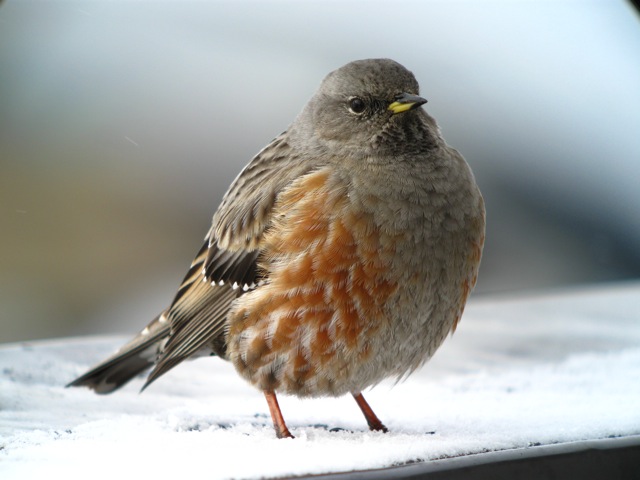
Alpine Accontor singing in spring. Digiscoped with Swarovski ATM80HD & Canon A590IS
A few years ago I moved to the Alps of Tirol and have been birding and digiscoping here ever since. The high mountain alpine zone (above the tree line) has grown very close to my heart: great open spaces, crazy alpine accentors, and wonderfully shy little blossoms. I work for Swarovski Optik as a product/marketing manager.
Looking forward to your posts and photos Dale!
Thanks Birding_is_Fun, this should be a great ride and we have lots of fun material lined up. It is only going to get better!
Excited to be hearing things from the Tirol!
What an interesting past you have had…looking forward to what you have to share!
@Dawn, that is just the beginning! This life for me is all about freedom, adventure and fun. I am sure there are many more wonderful paths to explore.
Great intro… (a summary of your life in four paragraphs, that takes skill, you left out that besides being bird mad you are a crazily-interesting individiual) looking forward to hearing about your birding adventures in the Alps!
Hi Charlie, what I lack in skill and whit, I make up for in enthusiasm, you are right. Considering the alternatives, I think I am fine with being a dimwit that really really really enjoys everything he does 😉