
Afromontane – A New World (and Word)
I guess mountains are so rare in Africa, that an adjective has been coined to describe the forests found there.
In the Neotropics, we say something more general, such as “tropical montane,” or “cloud forest,” I guess assuming that anywhere you have mountains in the tropics you get a resulting forest type. It turns out that the forests in the highlands of east-central Africa are completely different from anything I’ve seen in the Neotropics. And the resulting wildlife and birds are totally different.
First some background – I’m in Africa on vacation, my first trip to this continent and quite a departure from my usual travel routine, which is leading tours for WINGS in the Neotropics. When I’m traveling and not leading tours, it’s still to the Neotropics, either for scouting or with friends. So I’m totally out of my element here and really don’t know what I’m talking about. Nevertheless I’ll blog a bit about it and show some photos.
The political boundaries of the small country of Rwanda are draped over middle of a rolling highland that is the uplifted ridge on the eastern side of one of the main north-south oriented rifts of this spreading continent. Once covered in forest, the entire country, save for a couple tracts, sadly is utterly denuded of native vegetation. Here, near the Nyungwe Forest National Park in the Southwest, the highlands are draped in tea plantations.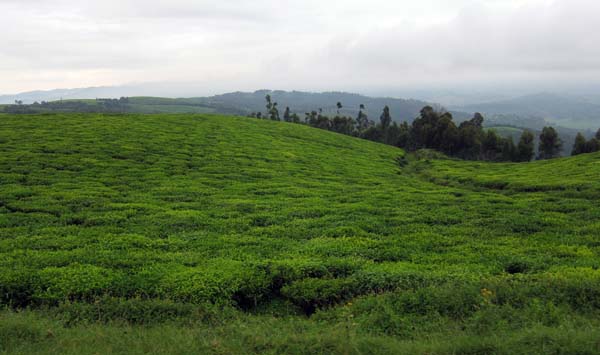
The Nyungwe is apparently the largest tract of remaining “Afromontane” forest in Africa. Of course, that’s a redundancy, but that’s why I don’t particularly like that word. In any event, it’s loaded with endemic species. One is the stunningly colorful Ruwenzori Turaco. When it flies, the primaries show their crimson red.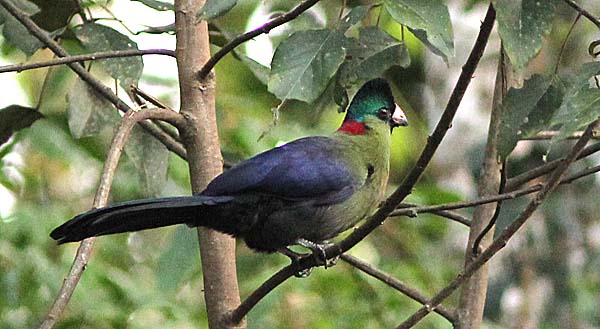
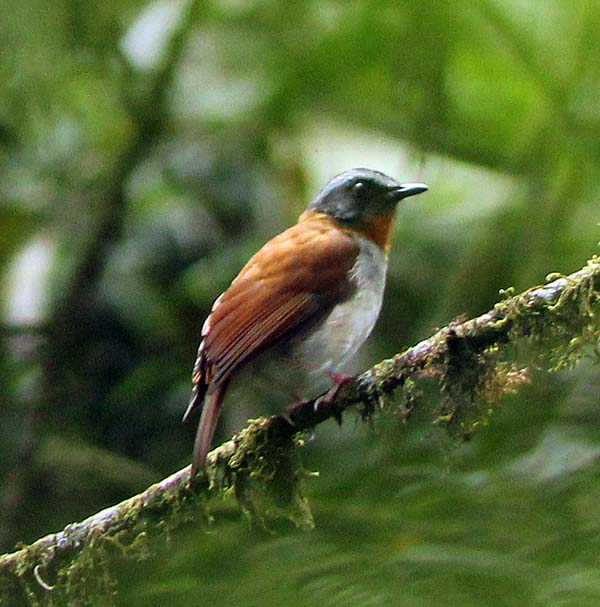
There are som 20-plus species of birds found only in these highlands, which stretch from Uganda in the north to Burundi in the south, and also on the other side of the rift in the Congo. Since the rift is the Albertine Rift, these are known as Albertine Endemics – and this is the most endemic-rich region of the continent. Let’s continue with one of the less colorful – Red-throated Alethe an Old World Flycatcher (Muscicapidae).
I love the colorful ones. Abundant along almost any roadside stop is Regal Sunbird, so much more pleasing to look at than the picture in the book. See the top of this post for a photo of this jewel.
Quite a bit more elusive, and one that my friends and I were really lusting after is the Blue-headed Sunbird.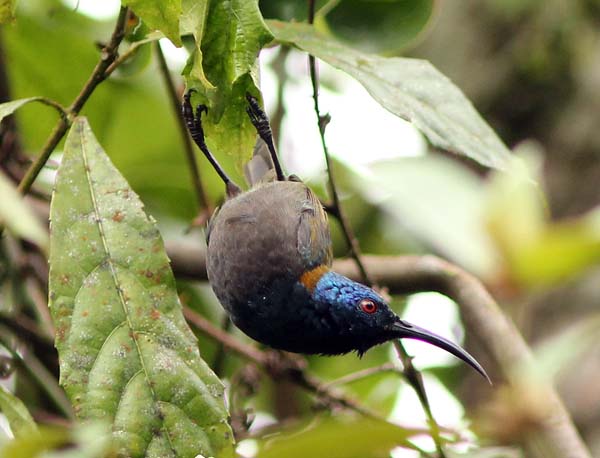
Not only birds are endemic. I arrived totally unprepared, but I still took picture of every butterfly for later identification. This is only one that I’ve identified – an acraeinine called Bematistes quadricolor.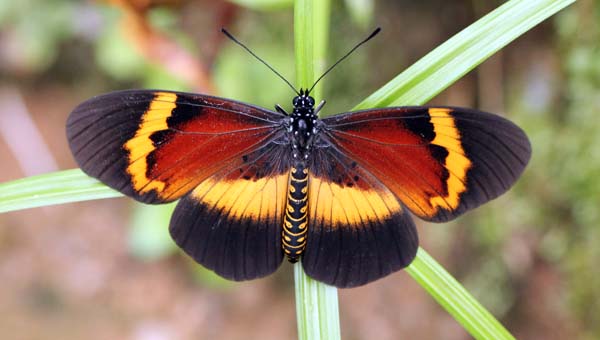
i grew up in (and loving) Afromontane forests. I mean, what is not to love about the robin-chats, sunbirds, turacos, and duikers?