
Wallcreepers!!!
At the moment, Susan Myers is doing a series on the Best 50 Birds in Asia. Susan, the Wallcreeper is the bestest bird in the whole wide world. And it occurs in Asia. So you better put it on your list!
Noting that I am obsessed with these silly little cliff running butterflies, I have been thinking a fair amount about them lately as the winter snows have increased. The bulk of our Wallcreepers (Tichodroma muraria) in Tirol, live up in the high alpine region, one the cliffs ridging the mountains and by November, these are in deep snow.
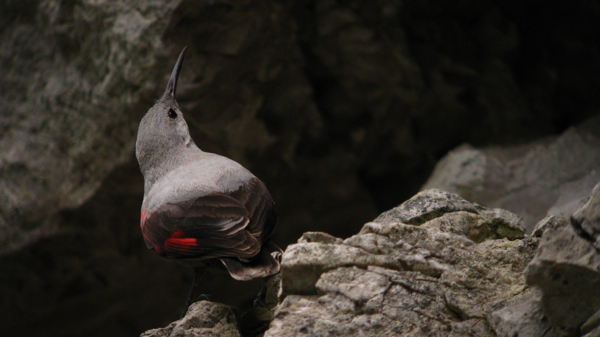
Female Wallcreeper at nest. Digiscoped with Swarovski ATM80 HD and Canon A590IS compact.
So what happens to the Wallcreepers in winter?
Well, we know that in Winter many individuals become nomadic, turning up on cathedrals and stone quarries all around Europe and Asian and oftentimes well away from the closest breeding areas. And we know that some stay in the lower altitude cliffs, canyons and gorges in the Alpine region (where they also breed), but I suspect that even though they also breed in these areas, I suspect that their home-ranges increase in size (where possible) and that many individuals are simply nomadic and that the Wallcrepers we see in a breeding area in winter are not necessarily the same ones that breed there in June.
But for me, one of the most remarkable observations is from a friend who has an Alpine hut / guest house at almost 2000m and last year, he had at least one Wallcreeper around his house and on the nearby cliffs ALL WINTER! And this winter it is back. Very cool. But how on earth do they do it? Find little insect food in such a snowy environment?
Hunting
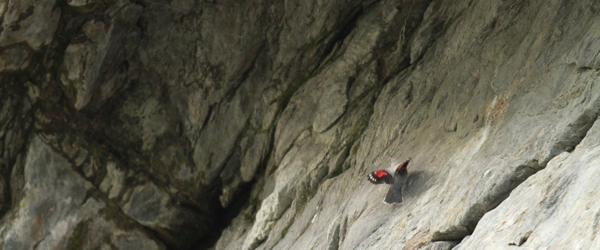
Maybe hunting is not the best way to describe what they do, but Wallcreepers are really fascinating to watch. Those bright crimson wings, with white spots, are perfect insect scaring tools. They creep along the cliff faces flicking their wings to get their surprise their insect prey in to moving – pretty much the best way to flush out well-camoflaged food in a hurry. They seem to have two different types of wing flick. There is the first which is a simple in-out, much like many flycatchers, chats, and numerous other insectivores. Then there is the really exciting, crazy wing flick where the Wallcreeper flicks with such enthusiasm and energy that the bird almost tips itself over:
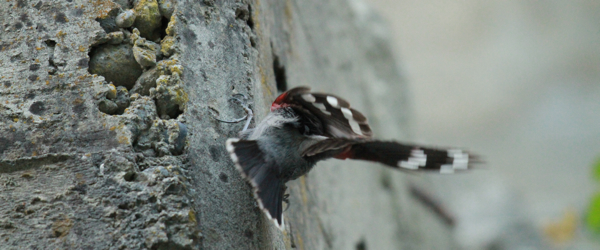
The enthusiastic fall-over wing flick of a male Wallcreeper
Wallcreeper Breeding
The Wallcreeper seems to use a wide variety of different holes/spaces/cracks for breeding. Here is some digiscoping video footage that I made of a Wallcreeper nest last year:
Wallcreeper call / song
The high pitched whistle is not the most melodious of calls, but I find it beautiful. In my experience, they call very rarely and for the most part, this is lost in the space of the mountains (doesn’t travel far) or is drowned out by the sound of rushing water (when in a canyon). This morning I read a fascinating article in which the authors show similarities in the calls of the Wallcreeper and a number of high-altitude Himalayan stream frogs, all living in very similar habitats (Dubois & Martens 1984). The authors suggest that this is a result of convergence call evolution based on the acoustic constraints of the steep gorges with loud, fast flowing streams.
The crimson butterfly
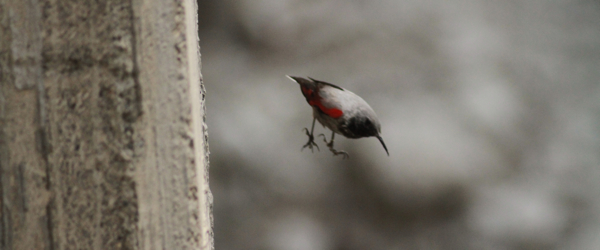
Step 1: Drop like a bomb
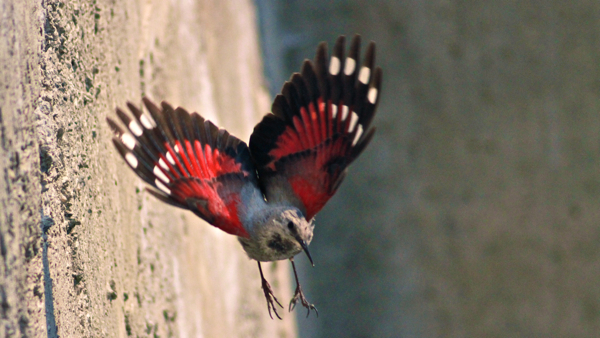
Step 2: spread that parachute out wide
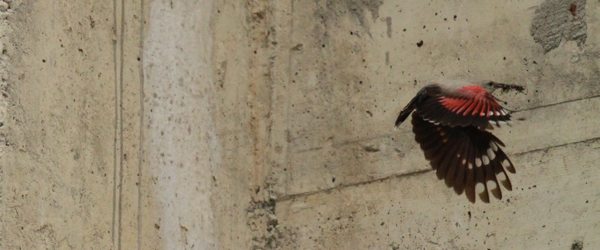
Step 3: flap about on those oversized wings looking like a crimson butterfly
All images digiscoped/videoscoped by Dale Forbes (c) with a Swarovski telescope. Please do not copy.
Happy birding,
Dale Forbes
OK, I’m hearing you Dale! Actually, it’s on the list – it’ll appear some time…
I would have had it first. But I suppose that is what I say now. Come to think of it I am not sure what I would have started my Asian top awesome bird short-list with. Methinks maybe a Gurney’s Pitta (or a banded), a couple of fingkishers, a red-bearded bee-eater, brown dipper, a hornbill or two, and a broadbill of some sort. Oh, and how could I forget a Palm Cockatoo?
I’ve got four words for you: Spec. Tac. U. Lar!! Certainly a contender for best bird in the world! Thanks for the great post!
ya, it is not just what the bird looks like; that is cool enough, but what makes it so awesome is its crazy flight, where it lives, that it somehow ekes out an existence on Alpine cliffs, its silly whistle call and that it is reeealy hard to find.
Great post, Dale. Bestest? Well, I’d put it in the top 10 for sure – which out of more than 10,000 is pretty good. And you digiscoped them all?? Good grief…it must have meant hours in the field. I remember in great detail my first and only on February 21, 1991 in a quarry in the Kaiserstuhl, which was a cold 1 1/2-hour bike ride on the snowy roads of the upper Rhine Valley. Worth every bit of it too.
bestest is a real word. you find it in the same section of the vocabulary guide book as ginormous and awesomest.
the very top photo (and most of my best wallcreeper photos) were taken with a $100 compact camera through a really good scope. The dropping butterfly photo is almost uncropped with a Canon 7D, TLS800 adapter and a Swaro STM80 HD scope.
Wow. The high pitched whistle is not the most melodious of calls.