
Just Add Migrants, then Chop, Slice, Stir
I live where I do (in northwest Ohio, USA) because it’s such a great place for observing bird migration. When I first got together with Kimberly, who is now my wife, she was working as a bird-bander in this phenomenal region; after I had visited here and seen something of the migration, I decided to move here. I’ve never regretted that choice. Here on the shoreline of Lake Erie we have spectacular movements of waterfowl, shorebirds, and especially long-distance migrant songbirds. The concentrations of American warblers in spring are so impressive that we’ve launched an event called “The Biggest Week In American Birding” (which was May 6 to 16 last spring and will be May 5 to 15 next spring – I told you it was a big week!). Thousands of birders come here from all over North America, as well as from Europe and elsewhere, and hardly anyone argues when we call this area “The Warbler Capital of the World.”
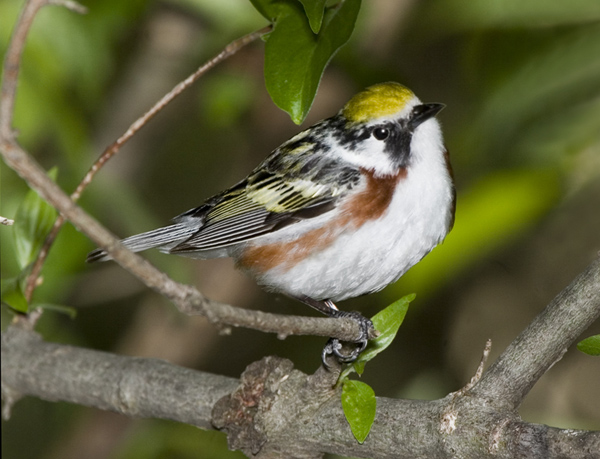
Male Chestnut-sided Warbler in spring. Photo by Kenn Kaufman.
Black Swamp Bird Observatory, the premier bird organization in n.w. Ohio, has been studying the migration here for years. More recently they have also made sure that the local business community recognizes the economic value of having all these birders visiting, so now the local hotels and restaurants put up “Welcome Birders” signs every spring and fall. Meanwhile, the welcome signs for migrating birds are already out, in the form of protected habitats along the Lake Erie shoreline. Places like Magee Marsh Wildlife Area, Ottawa National Wildlife Refuge, Maumee Bay State Park, and others have woodlots between the marshes and the open lake, and these woodlots swarm with migrants at the right seasons. (In the month of May, there are probably more warbler photos taken in northwest Ohio than in all the rest of the USA combined.) The migrating songbirds mostly travel at night, navigating by the stars, and coming down in the dim light of pre-dawn, funneling into the stopover habitats waiting for them on the lake shore. So the habitat in northwest Ohio is essential for the survival of large numbers of birds, the birds are essential for the enjoyment of the birders, and the visiting birders are important to the strength of the local economy.
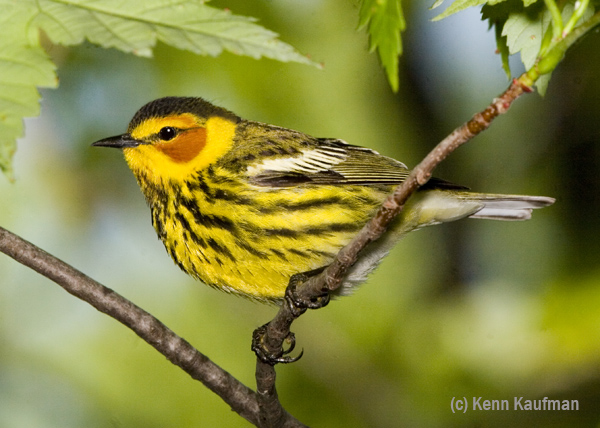
Male Cape May Warbler. Despite the name, it is far more numerous in spring in northwest Ohio than it is in Cape May, New Jersey! Photo by Kenn Kaufman.
Considering how this situation works, do you think it would be a good idea to build wind turbines – tall towers with long, spinning blades slicing through the air – right next to the most important stopover habitats in the region?
Yeah, I didn’t think much of the idea, either.
Black Swamp Bird Observatory, along with the Ohio Ornithological Society and Greater Mohican Audubon Society, has launched a petition asking for a three-year moratorium on construction of wind turbines within three miles of the lake shore in four counties of northwest Ohio. You don’t have to be an Ohio resident to sign the petition: local business owners are keenly aware that birders come here from all over the world, so wherever you are, you are a potential visitor.
So, if you agree with our concerns, please do consider signing this petition.
We are not against the idea of wind power. In some places, it may be a very good source of energy. But we don’t want these turbines placed in the middle of critical habitat for migratory birds. This stretch of the Lake Erie shoreline is the ONLY place in the world where endangered Kirtland’s Warblers are regularly seen on migration. The Kirtland’s, along with three dozen other warbler species and many vireos, thrushes, flycatchers, grosbeaks, tanagers, buntings, kinglets, sparrows, tanagers, and other birds, need safe havens to stop, feed, and rest during their migrations. There are plenty of other places to put wind turbines, but the birds don’t have so many choices.
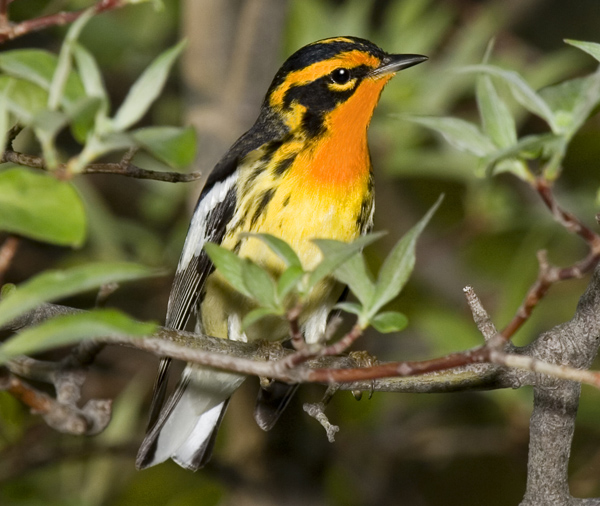
Adult male Blackburnian Warbler in spring. Photo by Kenn Kaufman.
Links to a lot more information can be found here.
And if you have the patience to read a long rant that I wrote on the subject last week, that rant is here.

But again, just reading this won’t accomplish anything. If you’re convinced, if you care, please sign the petition. Birders need to speak up if we’re going to have birds to watch in the future.
Not surprisingly, we face the exact same dilemmas in the UK. Like you, many of us don’t disagree with the value of wind power, we’re just occasionally baffled by the sites which are chosen. Not had Black-throated Green in the UK (recorded on the Azores), and I guess we might never at this rate…
Spectacular photos! I am putting the May dates on my calendar. I signed the petition of course, but I always feel so powerless in the face of major economic interests. So it’s good that local businesses realize the benefits of being a great birding hot spot and attracting many passionate (and well-off) birders.
We on the North Shore of Lake Superior are worried also. A study at the University of Minnesota Duluth is being undertaken to quantify the number of migrants – both passerines and raptors – that use the North Shore. Preliminary numbers are astounding.