
Alpine Accentors (Prunella collaris) in Tirol
The Alpine Accentor (Prunella collaris) is one of our most characteristic birds of the high Alps; breeding and spending the summer months almost completely above the treeline (about 1800m/6000ft asl in Tirol).
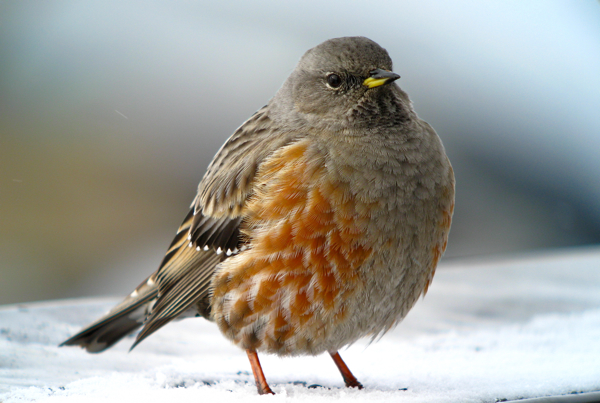
Alpine Accentor in his/her full glory. Digiscoped with a Swarovski scope and Canon A590
In late March, the Alpine Accentors return to their breeding areas from their lower wintering grounds (i.e. an altitudinal migration) but, from what I can tell of the accentors here in the Tirolean Alps, they seem to return to the general area where they have their territories but, because the food resources on the snow fields are still very limited, they spend a lot of time in inhabited areas, preferably those which are open and above the tree line. This typically means that one starts to see them around ski resorts, high-altitude ski villages, and lift stations.

preening
For a bird species that is typically very hard to get close to in their rough Alpine breeding habitat, early spring really is the time to see them. With a bit of luck, one can be treated to wonderfully confiding views as they hop from bench to bench, and sing from the roof-tops.
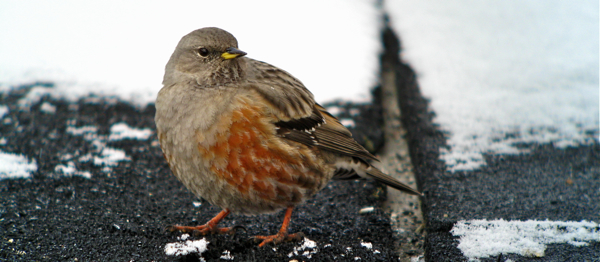
hanging out in a ski resort (Kühtai)
But do not expect to see flocks of Alpine Accentors anywhere. Even though they can be rather easy to find in certain areas, they are typically solitary when flitting through the ski resorts. I suspect that what may be happening is that some of the individuals are setting up and singing on the breeding territories, with others feeding near human settlements with the individuals in the polygnandrous group marriage relationship playing tag-team (even be it unconscious and unplanned).
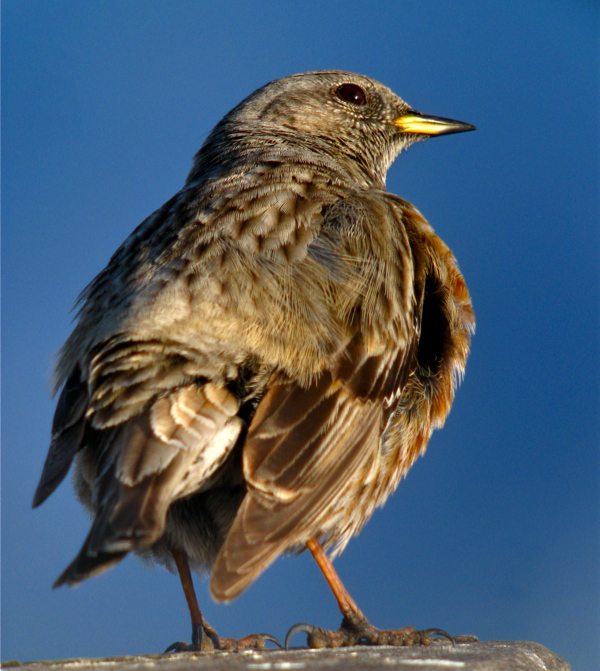
Enjoying the sun.
Their breeding biology has me absolutely fascinated: multiple males and females all participate in a form of “group marriage” called polygynandry (see my 10,000 Birds article on polygynandry in the Alpine Accentor here).
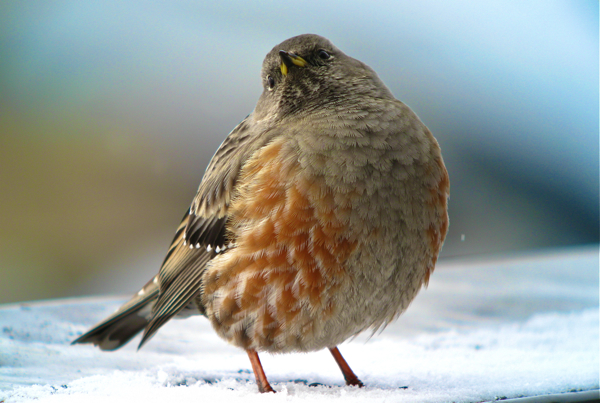
what are you doing, pointing that great big telescope at me?
If you are going to live in the high Alps, you are going to want to have a very close relationship with snow. These guys do not seem to be afraid of it at all. This bird looks like it is taking a snow bath:
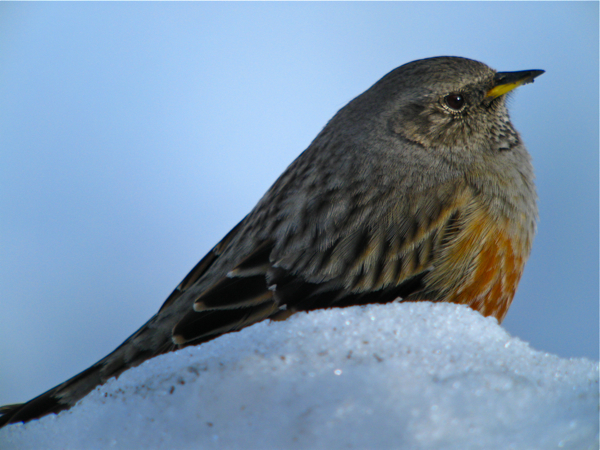
snow bath
180° view from Seegrube, overlooking Innsbruck – a typical Alpine Accentor hang-out in early spring:
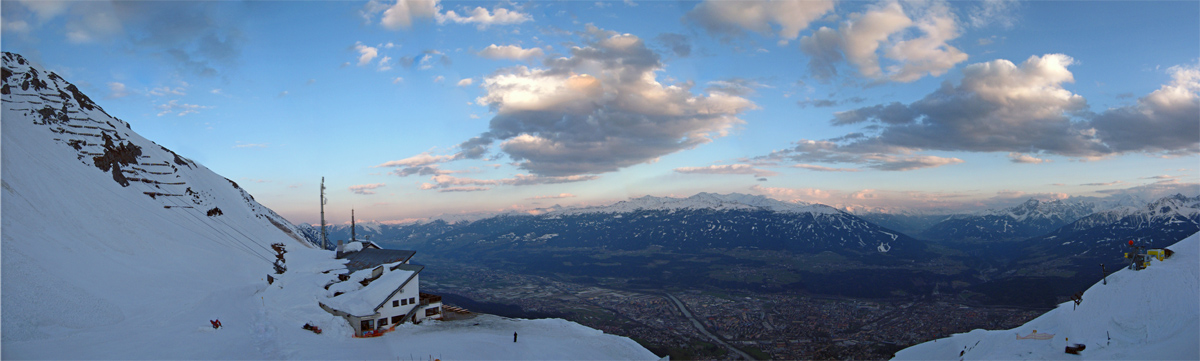
Click to see larger image.
happy birding
Dale Forbes
Thanks – Fun photos of a fascinating bird. If I ever get a chance to visit Europe again, Alpine Accentor is my top wish bird.
Thanks – Fun photos of a fascinating bird. If I ever get a chance to visit Europe again, Alpine Accentor is my top wish bird.