
SparrowTime
I am blessed to live in a major migration hotspot. Northwestern Ohio, USA, has fabulous concentrations of migrants in spring and fall. Visiting birders come here to see the waterfowl, the raptors, the shorebirds, the warblers — especially the warblers, which gather here in colorful throngs in May, earning this area the title of “Warbler Capital of the World.” But no one really talks about the sparrows. I imagine it could be a little discouraging to be a sparrow in the Warbler Capital.
But for those of us who live here, sparrows are important. After a long and harsh winter like the one we just had, the first big push of migrant sparrows in March is a welcome sign: it means that spring is actually on the way.
Sparrows and warblers don’t mix very well. The peak of sparrow migration is early in spring, well before the warblers show up, and late in fall, after most of the warblers have gone south. I had thought for a long time that this simply meant sparrows were tougher, better able to withstand cold temperatures. But earlier this week I was photographing some sparrows in the woods behind the Black Swamp Bird Observatory, and it occurred to me that the timing of their migration has another advantage.
Almost all of the North American sparrows are patterned in brown. They move south late in fall, after the leaves have turned, when most of summer’s green growth has withered to brown. They move north early in spring, before the woods and fields have sprouted much green yet, so they can still blend in with their surroundings. In their stopovers during migration, when they must spend their days in unfamiliar surroundings, it may give them a slight edge on survival to have the advantage of this natural camouflage. When I think of it that way, I can’t complain about their lack of bright colors. Even if they are mostly brown and gray, they have intricate patterns and shadings that can be beautiful with a close study.
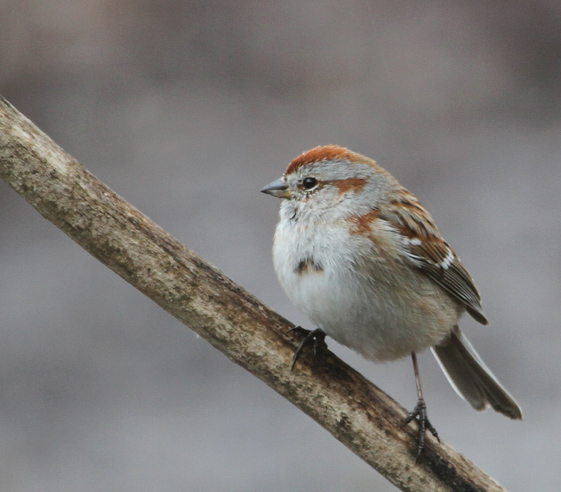
American Tree Sparrow. Nesting in far northern Canada and Alaska, it moves north early in spring. Photo by Kenn Kaufman.
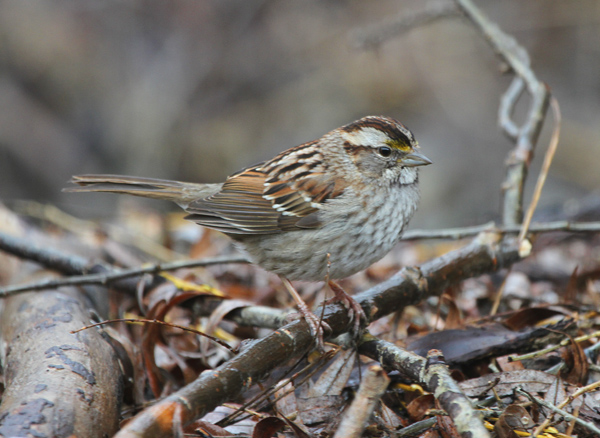
White-throated Sparrow. This species occurs in "white-striped" and "tan-striped" morphs, differing in head pattern (and in some aspects of behavior, too, oddly enough). Photo by Kenn Kaufman.
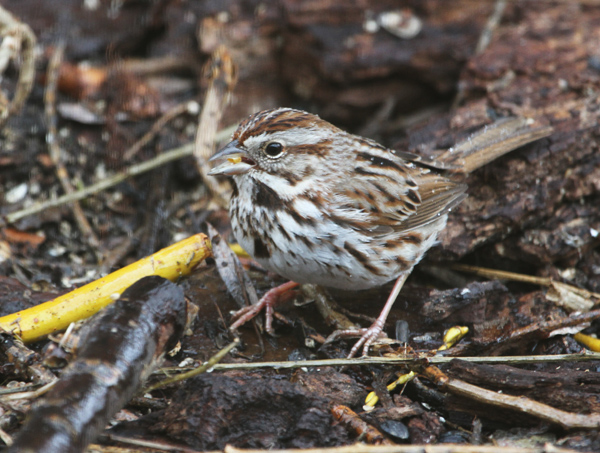
Song Sparrow. This species is found year-round in Ohio, but that doesn't mean it's non-migratory; a major influx of migrants comes through in March. Photo by Kenn Kaufman.
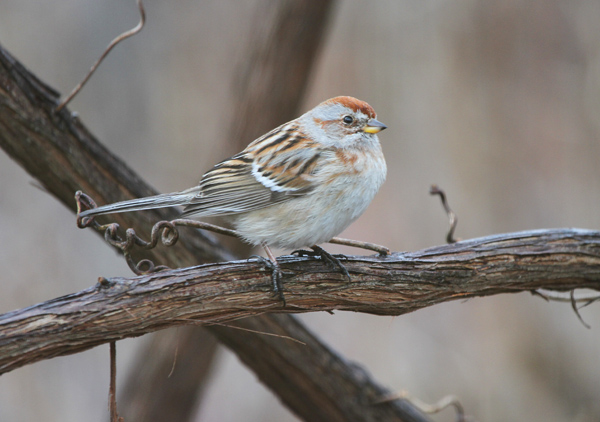
American Tree Sparrow. It's called that to distinguish it from the European Tree Sparrow, but most of its nesting range is in Canada -- and, ironically, mostly north of tree line. Photo by Kenn Kaufman.
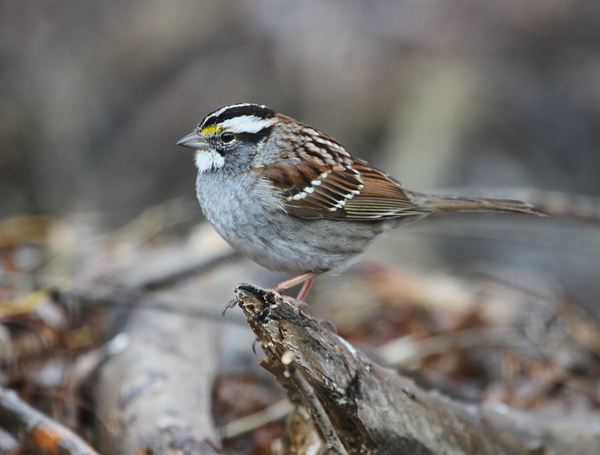
White-throated Sparrow. It's a sharp-looking bird, but the most beautiful thing about it is its song: "Oh, Sweet, Kimberly-Kimberly-Kimberly." Photo by Kenn Kaufman.
Kim was telling me the other day about all the sparrows moving through, sounded really cool. With its strong facial patterning, the bottom white-throated sparrow looked a lot like an old-world bunting and, as I have just learned from Wikipedia, new world sparrows and old world buntings are very closely related (and somewhat less related to old world sparrows). In fact, it is likely that our buntings may come from South American Emberizidae sparrows and that they spread up through North America, across the Beiring Straight and then across Asia in to Europe. Talk about a long journey.
But I do have a question, did you playback the call of the white-throated when wooing your wife?
Nice post Kenn. I have to admit I didn’t get the Extra Points, but I bet you will.
https://punkrockbigyear.blogspot.com/
Nice post Kenn. I have to admit I didn’t get the Extra Points, but I bet you will.
https://punkrockbigyear.blogspot.com/
Great post and pics Kenn! I love the American Sparrows, it must be a fine thing living in the sparrow and warbler capital. I remember in Cape May seeing the Sparrows move through in late Autumn and loving the challenge of so many different new sparrow species in various ‘niche’ habitats.